Reimagining the Ground Beneath Our Feet
There is a quiet revolution taking place beneath our feet—not in the soil, not in the garden, but inside our homes, studios, lobbies, and galleries. In an age increasingly defined by digital saturation and architectural minimalism, a yearning for authenticity, texture, and connection to the natural world is reemerging. We seek spaces that breathe, that tell stories, that offer solace—not just shelter. It is within this cultural and aesthetic shift that the Wildflower Epoxy Shaped Floor has quietly taken root, not merely as a surface, but as a poetic gesture toward the living earth.
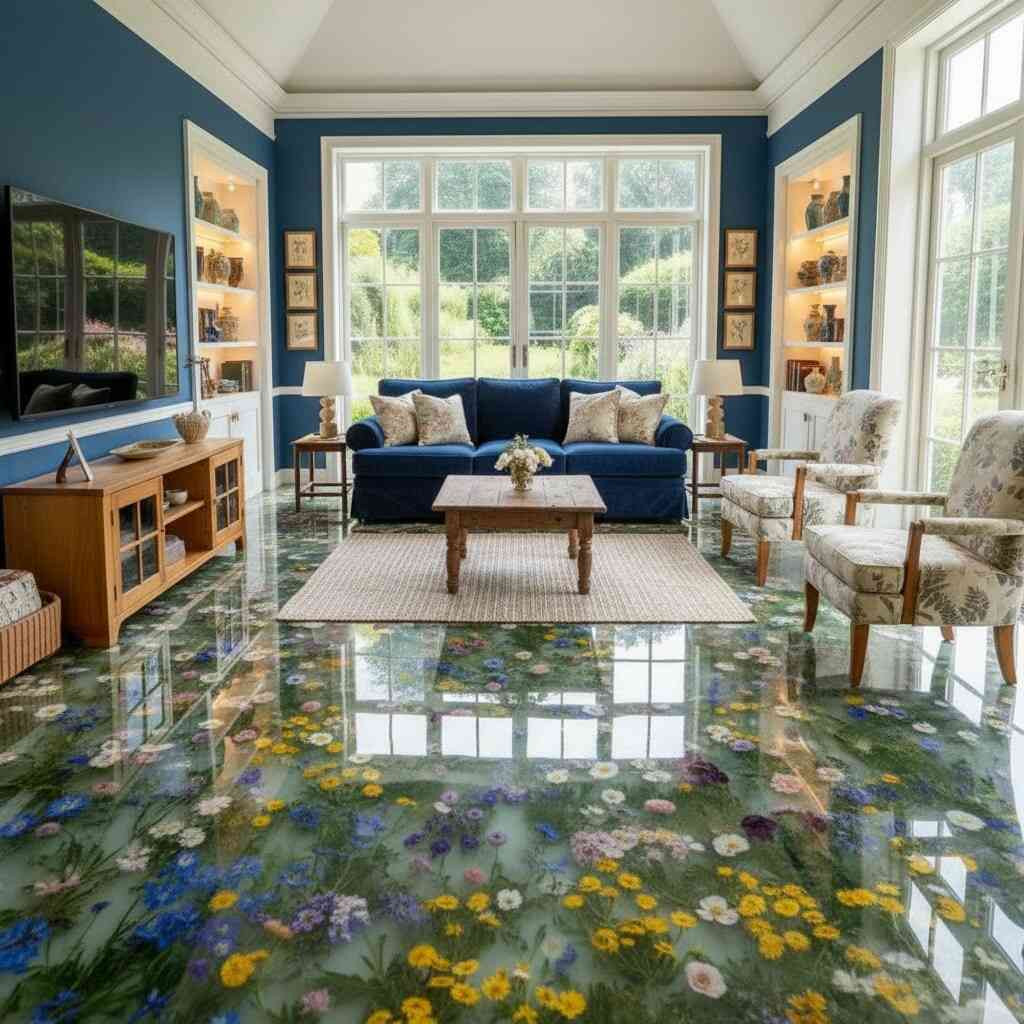
Unlike conventional flooring solutions—uniform tiles, industrially milled wood, cold polished concrete—the Wildflower Epoxy Shaped Floor does not aim to tame nature, but to evoke it. Its form is not imposed but suggested; its beauty lies not in perfect symmetry but in the asymmetrical grace of a meadow in midsummer. This is not flooring that imitates nature in a literal, photographic sense. Rather, it translates the essence of wild botanical life—its spontaneity, its layered complexity, its quiet resilience—into a permanent, yet deeply expressive, architectural element.
In this article, we explore how the Wildflower Epoxy Shaped Floor functions as a conduit for organic beauty in interior environments. We examine its material philosophy, its dialogue with light and space, and the emotional and psychological resonance it creates. Through three interwoven perspectives—Material as Metaphor, The Poetics of Imperfection, and A Dialogue Between Interior and Ecology—we delve into why this particular approach to surface design feels so profoundly timely, even necessary, in our contemporary built world.
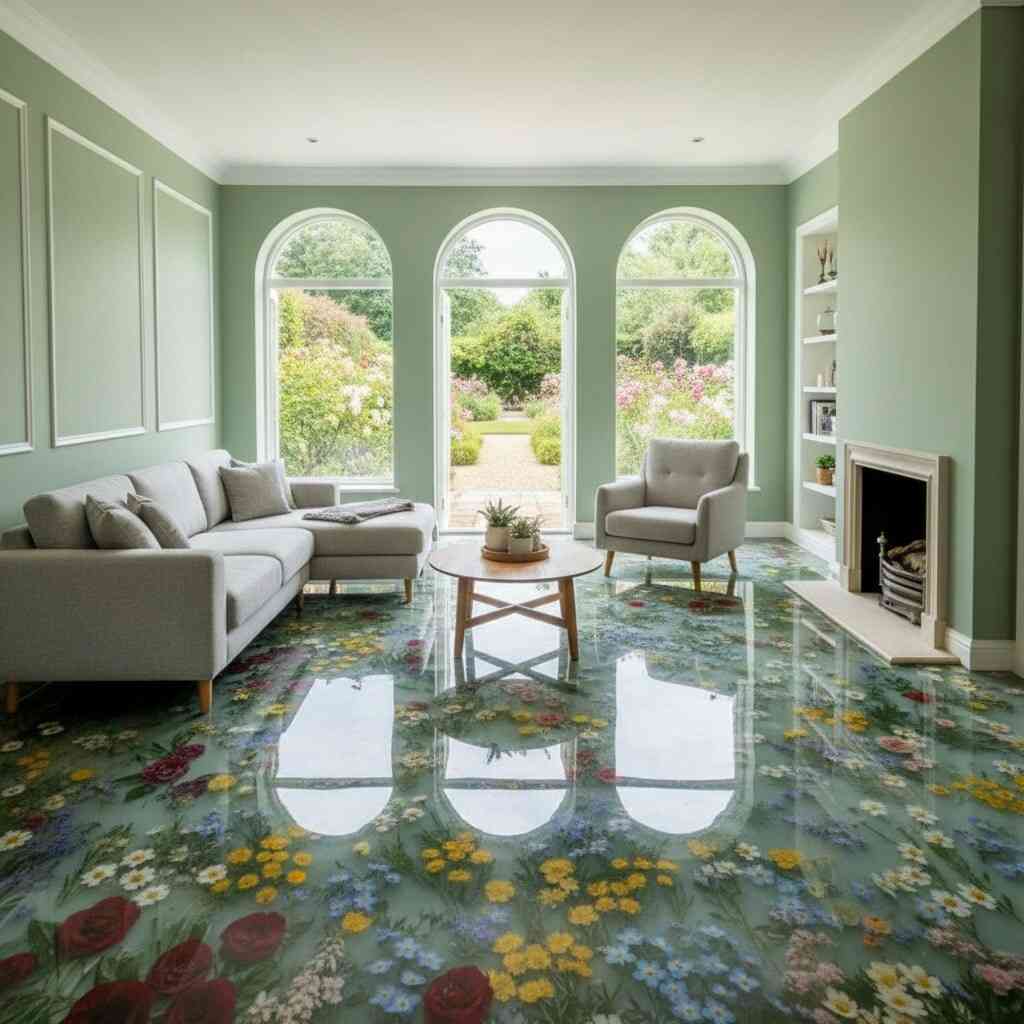
Part I: Material as Metaphor — Epoxy Reimagined Beyond Utility
Epoxy, as a material, has traditionally been associated with function above form: durability, chemical resistance, seamless finishes for laboratories, garages, and commercial kitchens. Its reputation is one of sterility, of control—qualities antithetical to the untamed vitality of wildflowers. Yet, in the hands of artists and material designers attuned to organic rhythms, epoxy undergoes a radical redefinition. It ceases to be merely a binder or protective coating and becomes a medium of expression—a translucent matrix capable of holding memory, color, and gesture.
The Wildflower Epoxy Shaped Floor begins not with a mold or template but with a process deeply responsive to natural precedent. Pigments—derived not only from synthetic sources but also from mineral oxides, plant-based dyes, and even finely ground botanical inclusions—are layered in thin, flowing pours. These are not applied in uniform coats but manipulated with tools that mimic natural forces: rakes emulate wind-swept grasses; soft brushes suggest the delicate unfurling of petals; controlled drips echo morning dew descending a stem. The epoxy, in its liquid state, is coaxed—not forced—into formations that recall the way Coreopsis clusters along a sunlit path or how Lupine spikes rise in staggered succession.
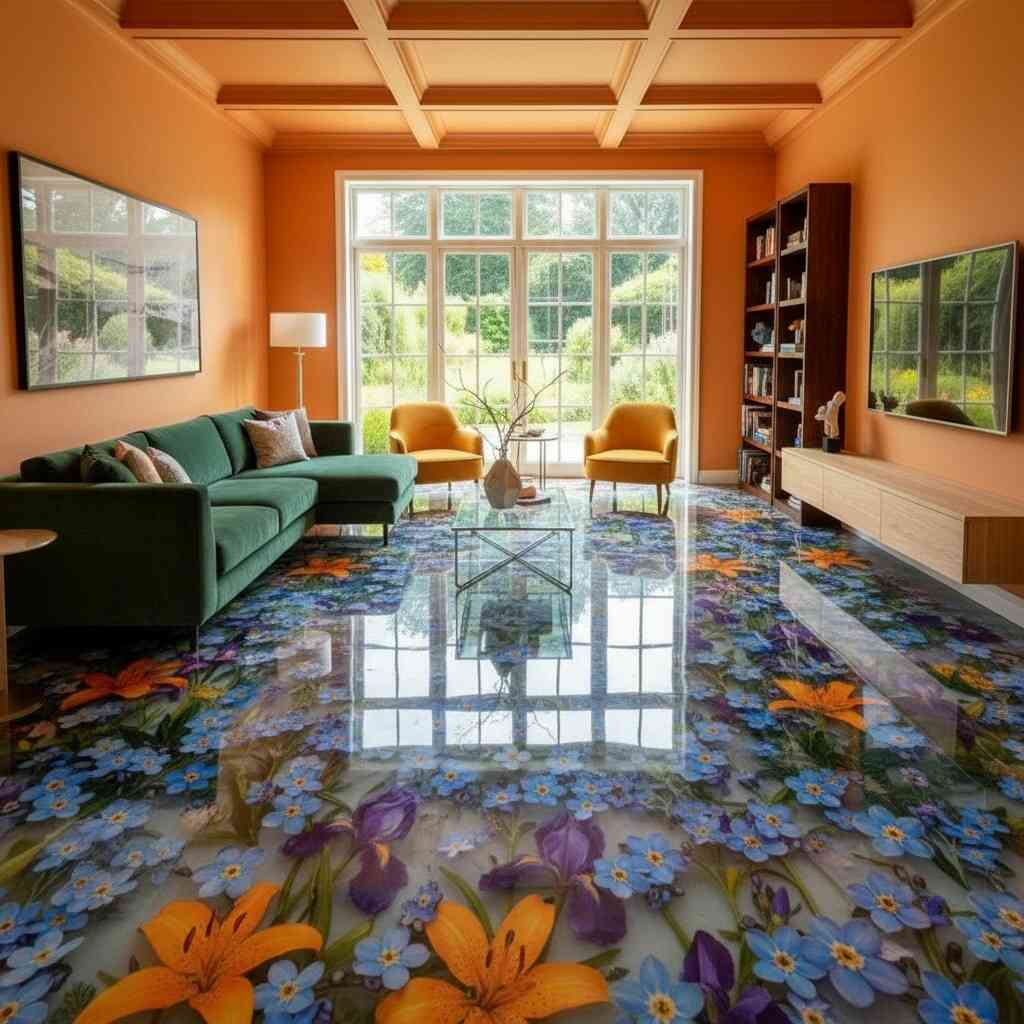
Crucially, the shaping is not representational. There are no stenciled outlines of poppies or daisies. Instead, the floor captures the phenomenology of wildflower growth: the clustering, the gradation of hue as species intermingle, the way light filters through layered foliage. The “shaping” refers not to rigid geometry but to the organic contouring of color fields—edges that feather and soften, centers that deepen like shaded hollows, margins that taper like receding tide lines. These contours are fixed only after the epoxy cures, locking in a moment of fluid movement—a paradox of permanence preserving transience.
This material alchemy transforms epoxy from inert substrate into a kind of fossilized moment in a meadow’s life cycle. Walk across such a floor, and one does not tread on decoration but on a recorded atmosphere—the warmth of late spring, the hum of pollinators, the subtle shift of light from dawn to dusk, all distilled into chromatic gradients and textural undulations. The floor becomes a threshold—not between rooms, but between the cultivated interior and the unruly, generative world beyond the window.
It is this metaphoric dimension that elevates the Wildflower Epoxy Shaped Floor beyond aesthetic novelty. It invites us to reconsider what building materials can mean. In a culture where surfaces are often designed for easy maintenance and visual neutrality, this approach insists on presence—on the floor as participant, not backdrop.
Part II: The Poetics of Imperfection — Celebrating Entropy and Emergence
Modernist design long championed the ideal of the “machine-made”—smooth, precise, repeatable. Yet human beings are not machines, and our environments suffer when they deny the rhythms of growth, decay, and renewal inherent in all living systems. The Wildflower Epoxy Shaped Floor resists homogeneity. It embraces what might once have been considered flaws: variations in pigment density, slight textural irregularities, the subtle pooling of resin in low-lying contours. These are not defects but signatures—evidence of the hand, of time, of material agency.
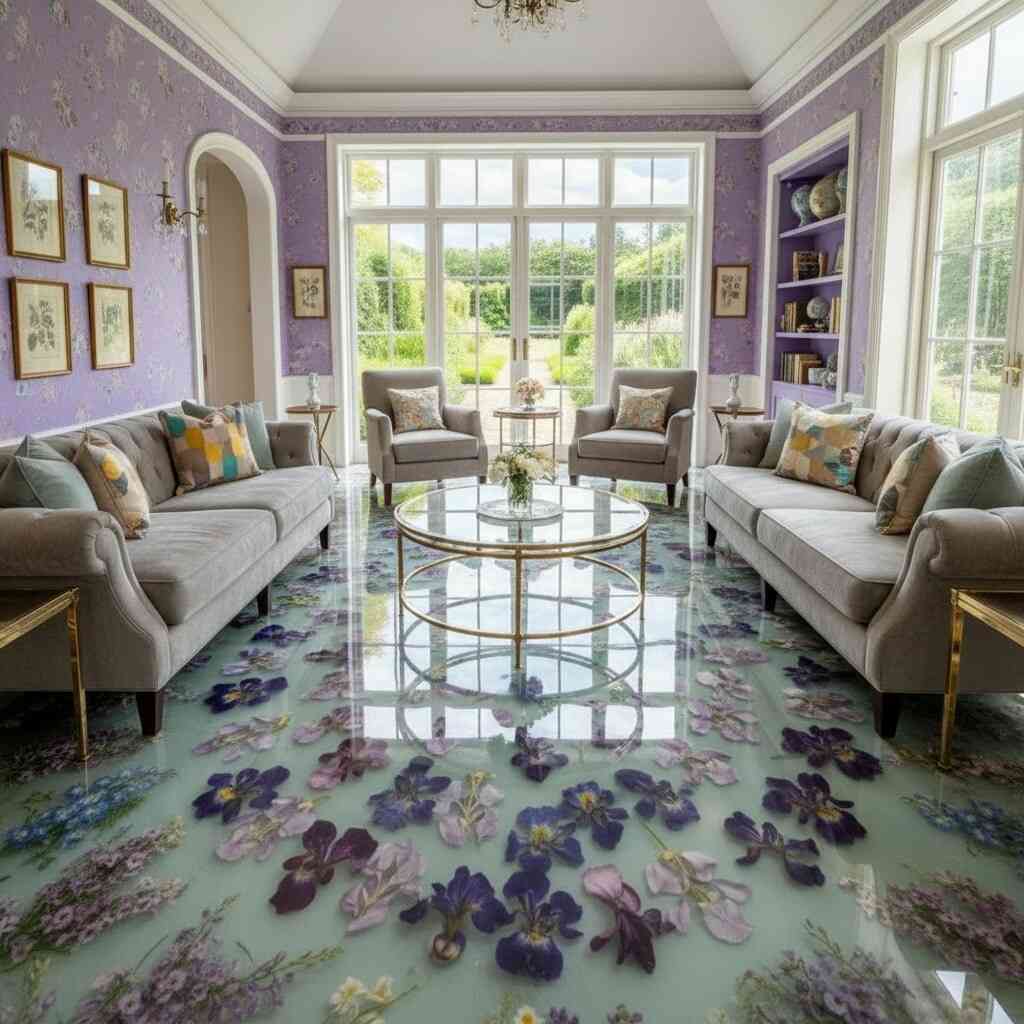
Consider the way wildflowers colonize a landscape: not in straight rows, but in patches and drifts, responding to microclimates, soil composition, and the shadow of neighboring plants. Some areas bloom densely; others remain sparse, allowing earth or stone to peek through. This heterogeneity is central to ecological resilience—and it is mirrored in the Wildflower Epoxy Shaped Floor. A given installation may feature a concentrated burst of violet and gold in one quadrant—a suggestion of Verbena and Black-eyed Susan—while thinning into pale greens and ochres elsewhere, evoking the transition from bloom to seed-head, from abundance to rest.
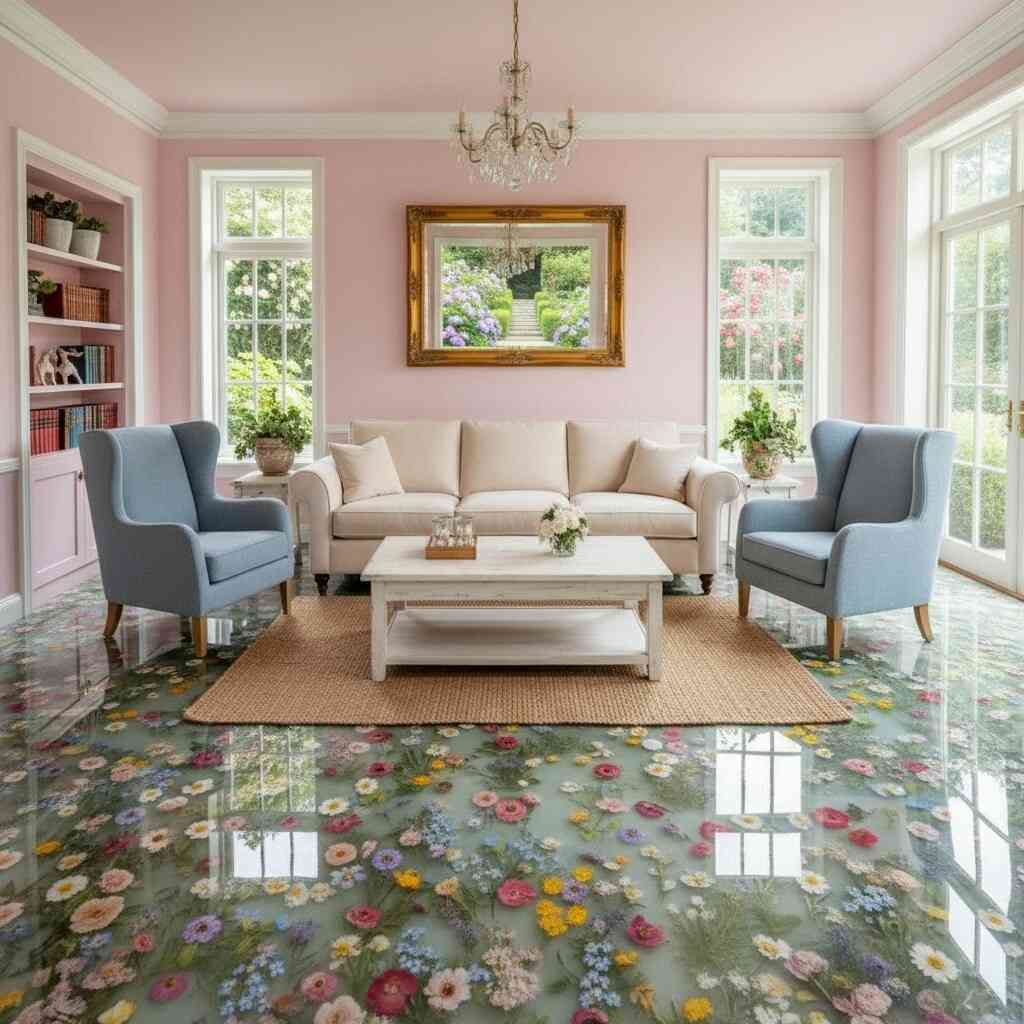
This intentional irregularity fosters a dynamic visual experience. As light shifts across the day—morning sun striking at a low angle, midday glare diffused by sheer curtains, evening lamplight casting long shadows—the floor reveals new details. A ripple of iridescent mica, embedded at varying depths, catches the light like dew on spider silk. A faint crackle effect, induced by controlled thermal variation during curing, mimics the delicate fracturing of dry soil after rain—yet remains structurally sound, a celebration of surface tension and release, not failure.
The poetics extend to scale and perception. From a distance, the floor may read as an abstract wash of color—soft, atmospheric, calming. As one approaches, layers emerge: fine filaments suggesting grasses, stippled accents hinting at seed dispersal, veils of translucent glaze evoking morning mist. Kneel down—touch the surface—and you may discern the faintest relief, not sculpted but grown, like the raised veins of a leaf pressed into sedimentary rock.
This multi-scalar richness counters the flatness so prevalent in contemporary interiors. In an era of screens and smooth interfaces, the Wildflower Epoxy Shaped Floor reintroduces tactile depth—a reminder that beauty resides not only in the eye but in the body’s engagement with space. It asks us to slow down, to observe, to witness—qualities increasingly rare in accelerated environments.
Moreover, its “imperfection” carries philosophical weight. It challenges the modern obsession with control and predictability. Wildflowers thrive despite—and often because of—disturbance: fire, grazing, seasonal drought. Their beauty is inseparable from their adaptability. The floor, in its gentle irregularities, becomes a quiet manifesto: There is dignity in resilience. There is elegance in letting go.
Part III: A Dialogue Between Interior and Ecology — Re-enchanting Domestic Space
Architecture has long sought to separate interior from exterior—to create sanctuaries of climate control, acoustic isolation, and visual order. But this separation, while practical, exacts a psychological cost. Studies in environmental psychology consistently affirm that exposure to natural patterns, organic forms, and biophilic design elements reduces stress, enhances creativity, and fosters a sense of belonging. Yet for many, access to daily contact with nature is limited—especially in dense urban environments.
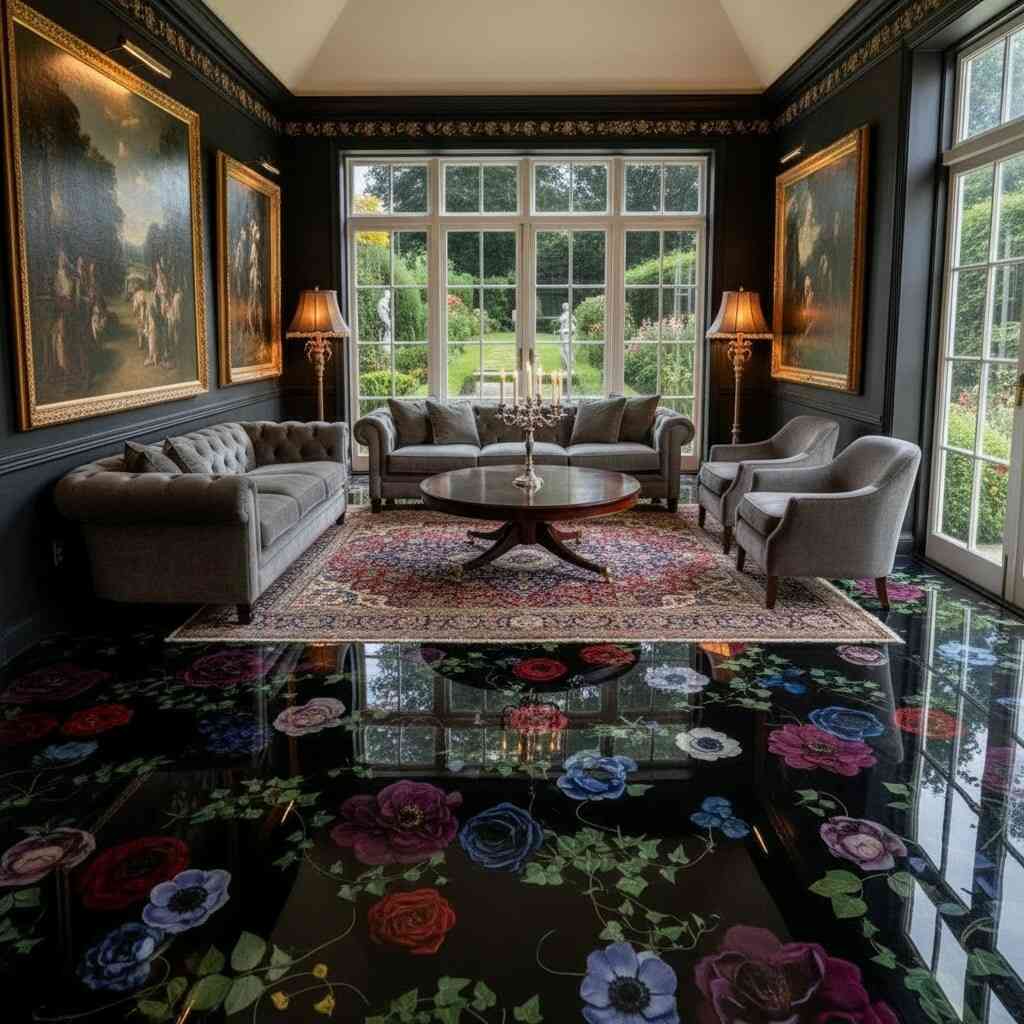
The Wildflower Epoxy Shaped Floor offers a non-literal but deeply felt reconnection. It does not bring the outside in through literal replication (no fake grass or 3D-printed daisies). Instead, it internalizes the principles of wild ecosystems: diversity, interdependence, cyclical change.
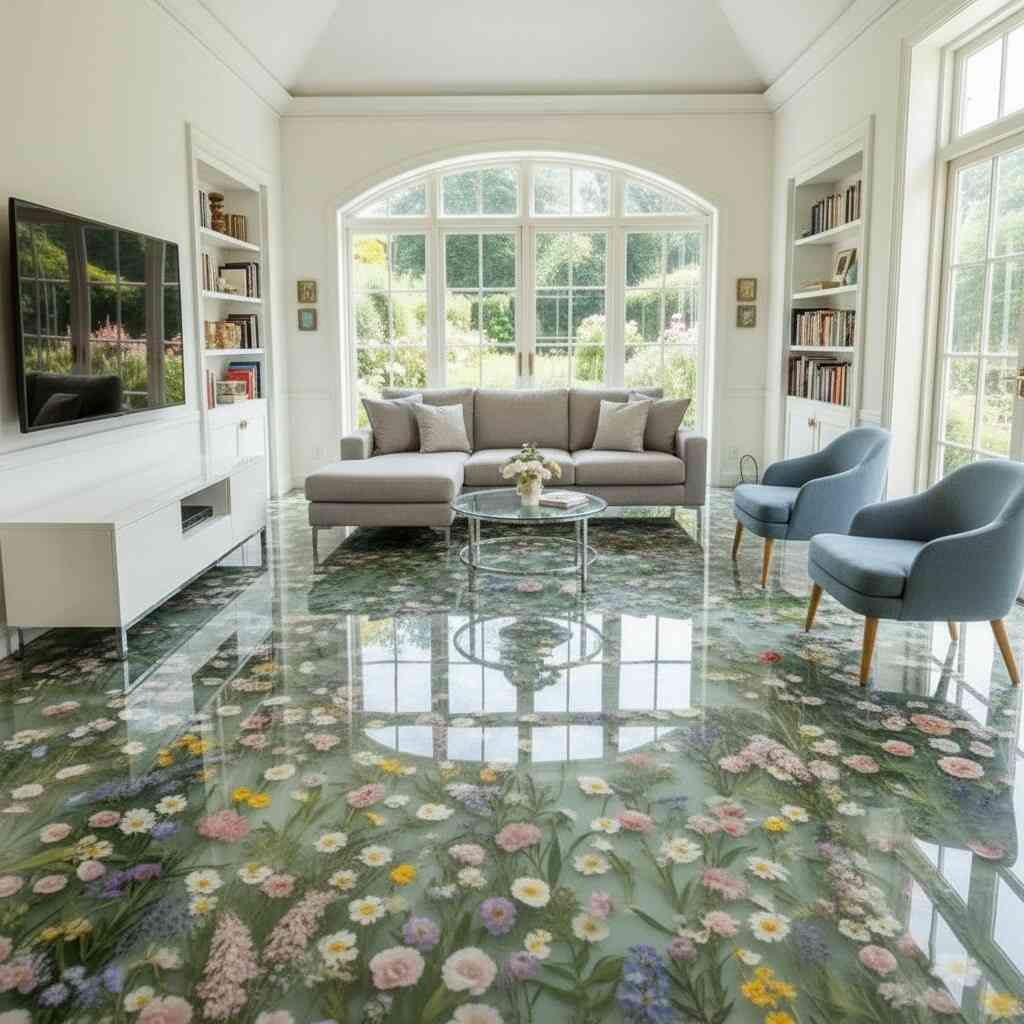
Imagine a sunroom where the floor flows from a deep indigo—suggestive of Salvia at twilight—into warm amber pools that recall the last light on dried Queen Anne’s Lace. The transition is not abrupt but meditative, like walking from shade into sun along a woodland edge. Or consider a minimalist studio apartment: white walls, clean lines, a single skylight. The floor becomes the protagonist—a living canvas that shifts with the weather outside. On overcast days, its muted tones harmonize with the gray sky; on bright afternoons, its embedded pearlescent pigments shimmer, as if the room itself were breathing light.
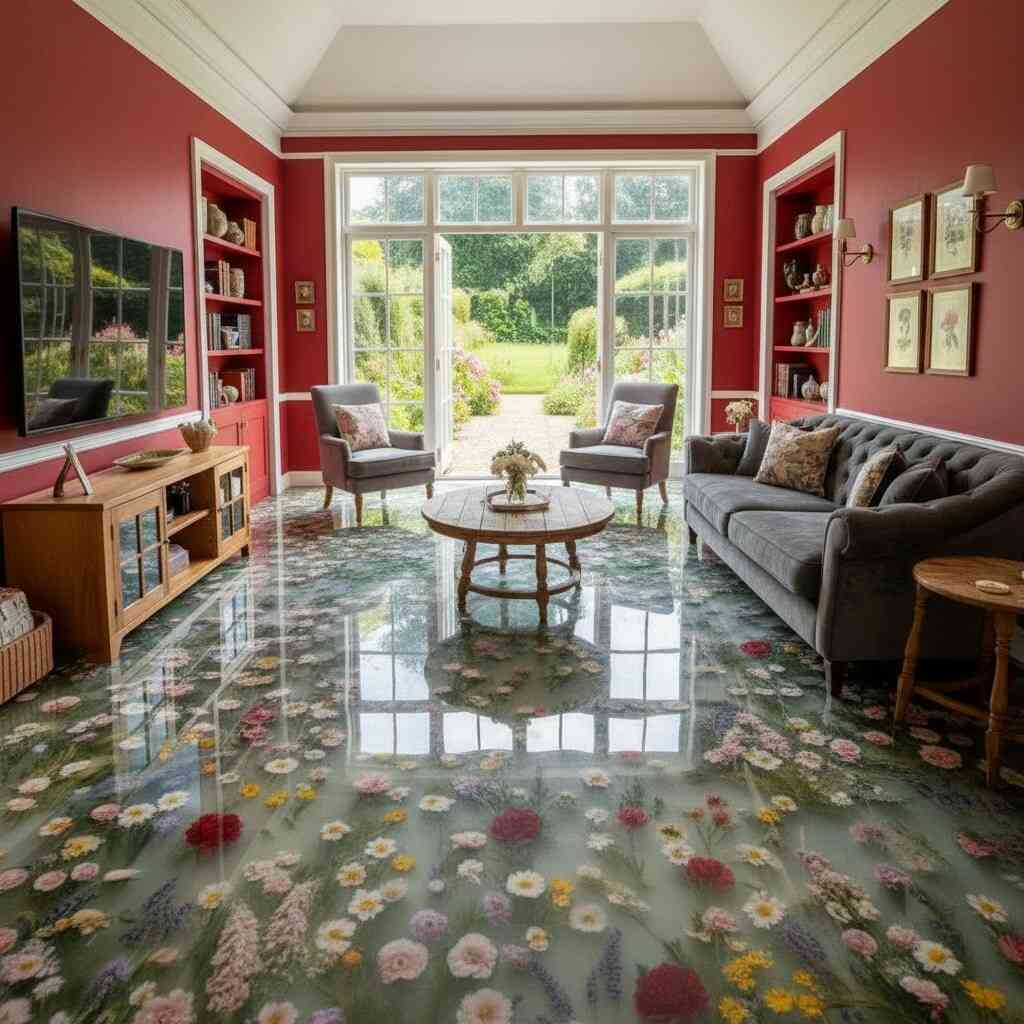
This is more than decoration; it is spatial storytelling. The floor becomes a subtle narrative device, evoking seasonality, locale, even memory. A design inspired by Pacific Northwest meadows—featuring mossy greens, slate grays, and bursts of fireweed pink—anchors a space in a specific bioregion, cultivating a sense of place, even for those far from it. In a child’s playroom, a floor suggesting a spring meadow—soft yellows, tender greens, scattered white accents—becomes an invitation to imagination: to lie down and watch clouds drift across an indoor sky, to trace invisible bees from bloom to bloom.
Critically, the Wildflower Epoxy Shaped Floor avoids the pitfalls of kitsch or escapism. It does not pretend to replace real nature; it does not suggest that a synthetic surface can replicate the scent of crushed thyme or the buzz of a bumblebee. Rather, it functions as what philosopher Gaston Bachelard called a material reverie—an object that stimulates the imagination, that opens a door to contemplation. It is a prompt, not a substitute.
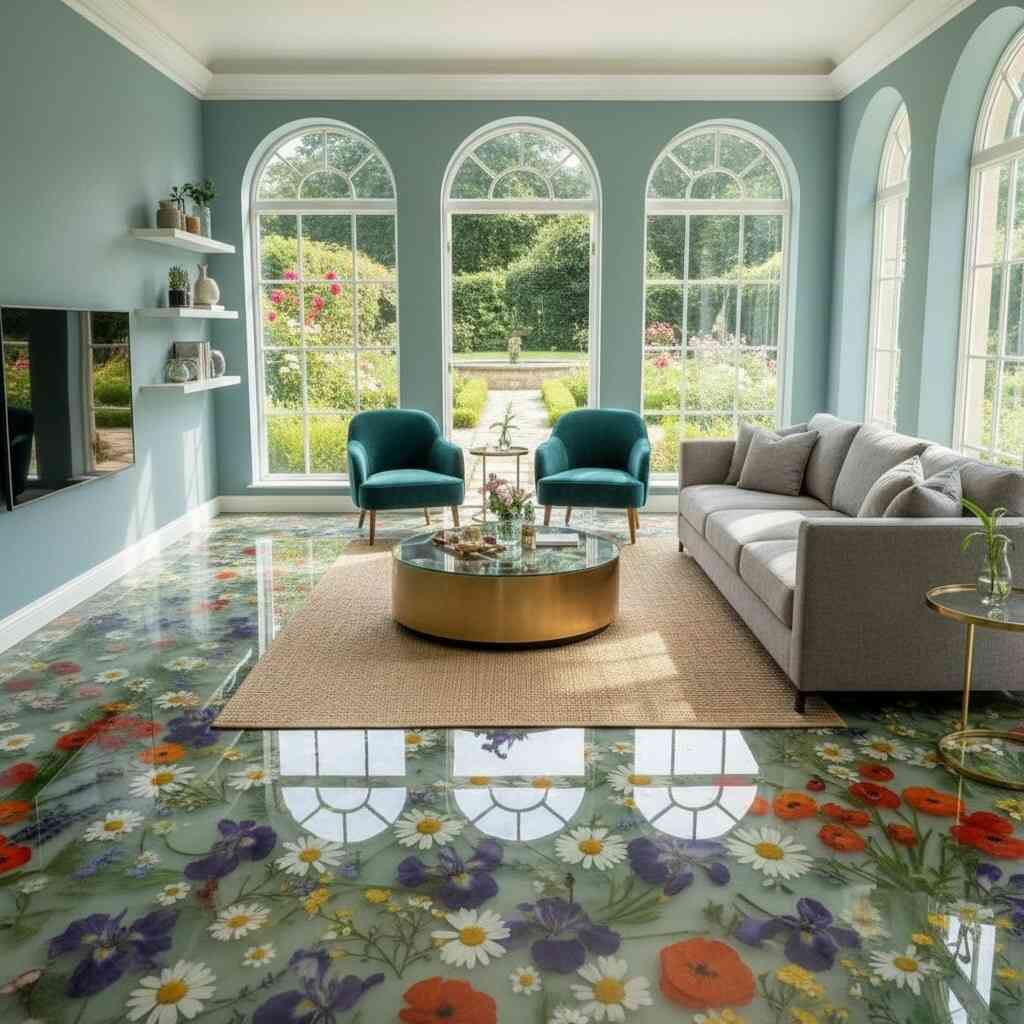
In this way, it contributes to what cultural theorist Andreas Weber terms “enlivenment”—the re-sacralization of matter, the recognition that even human-made things can participate in the web of aliveness if designed with attentiveness and humility. The floor does not dominate the space; it accompanies it. It supports—literally and metaphorically—our movements through the day, grounding us in a visual language older than architecture: the language of growth, bloom, seed, rest.
And in doing so, it quietly challenges the boundary between built and grown. Is the floor inside the house? Or is the house a shelter within the meadow? The distinction softens. The interior becomes permeable—not physically, but perceptually. We are reminded that we, too, are part of an ecology—that our homes are not fortresses against the world, but nests within it.
Conclusion: A Surface That Sings in the Key of Earth
The Wildflower Epoxy Shaped Floor is not a trend. It is a response—a tender, thoughtful response—to a deep cultural longing: to dwell not just efficiently, but meaningfully; not just comfortably, but consciously.
It resists the flattening forces of mass production and algorithmic design by insisting on nuance, on process, on material intelligence. It honors time—not by resisting change, but by embedding the memory of change into its very structure. It celebrates biodiversity—not through didactic illustration, but through chromatic and textural polyphony.
Most profoundly, it reorients our relationship to the ground. For millennia, humans walked barefoot on earth, sand, grass—surfaces that shifted, yielded, and spoke back. Modern flooring often silences that dialogue: hard, cold, inert. The Wildflower Epoxy Shaped Floor reopens the conversation. It does not mimic soil, but it echoes it. It does not grow, but it remembers growth.
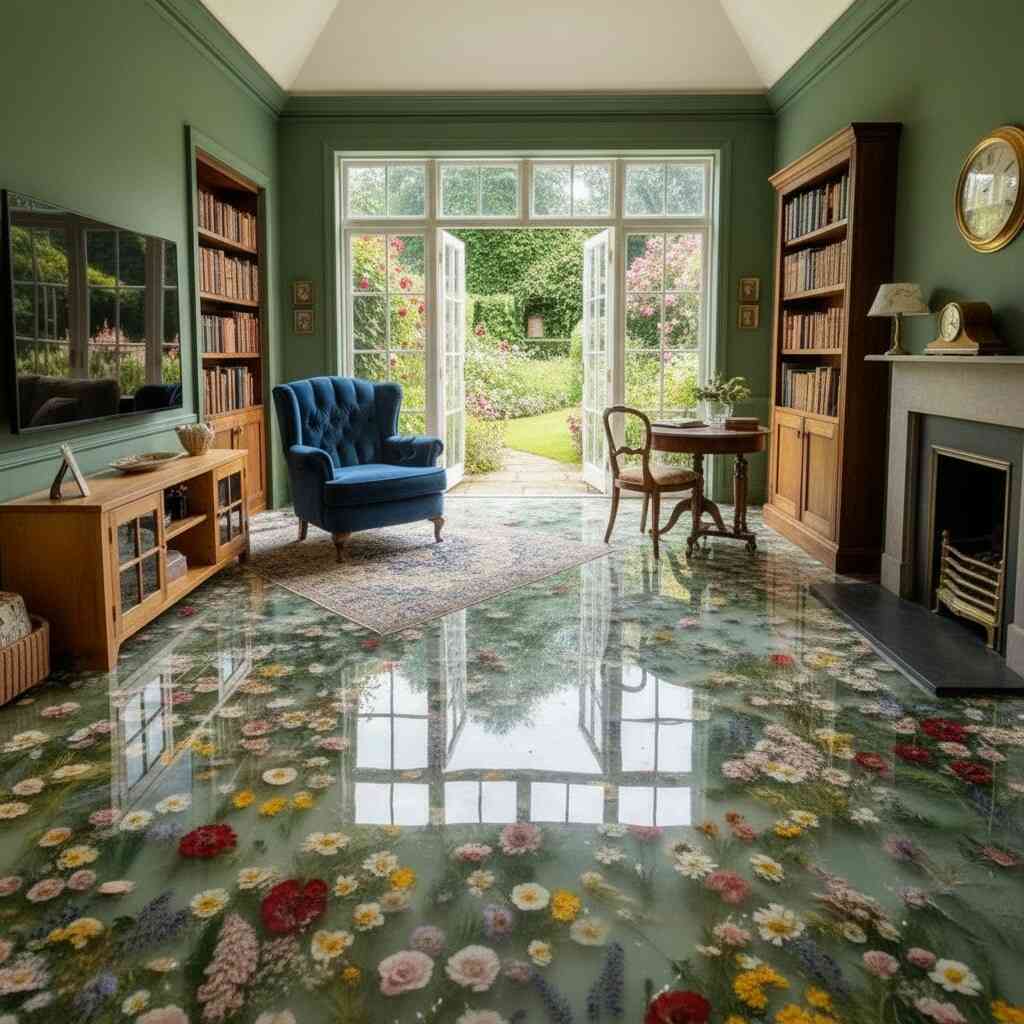
To walk across such a floor is to participate in a quiet act of re-enchantment. It is to feel, however subtly, that the space around you is not dead matter, but a continuation of the living world—filtered, interpreted, and offered back as beauty.
In a time of ecological uncertainty, such gestures matter. They do not solve climate change or halt habitat loss. But they recalibrate our attention. They train us to see complexity where we once saw sameness, resilience where we expected fragility, poetry in the pattern of a petal’s fall.
The Wildflower Epoxy Shaped Floor asks only this: that we pause. That we look down—not to check our phones, but to witness the ground, reimagined. And in that pause, perhaps, we remember: we are not above nature. We are of it. And sometimes, the most radical thing an interior can do is to let the meadow in—not through the door, but through the floor.