Few spaces in the modern home are as paradoxical as the garage. It is a threshold—part entryway, part utility zone, part storage cavern, and for many, part workshop, gym, or creative studio. Yet for decades, this multifaceted domain has been consigned to the raw pragmatism of exposed concrete: cracked, stained, porous, and perpetually dust-laden. The floor—the literal foundation of the space—has long been overlooked, treated not as a surface with potential, but as an afterthought, a relic of construction left to weather time and neglect.
Enter epoxy garage flooring: not merely a coating, but a transformative medium. More than a cosmetic upgrade or a protective sealant, epoxy represents a fundamental reimagining of what a garage floor can be—how it functions, how it endures, and how it contributes to the sensory and psychological experience of the space. Its rise in residential and commercial applications signals more than a trend; it reflects a growing recognition that environments shape behavior, that utility and beauty need not be mutually exclusive, and that even the most utilitarian spaces deserve intentionality.
This article explores how epoxy garage flooring reconfigures both functionality and aesthetics—not in isolation, but in dynamic interplay. We’ll examine how its material properties recalibrate durability, hygiene, and safety; how its visual versatility enables personal expression and spatial harmony; and how, ultimately, it serves as a quiet but potent catalyst for redefining the garage’s role in contemporary life.
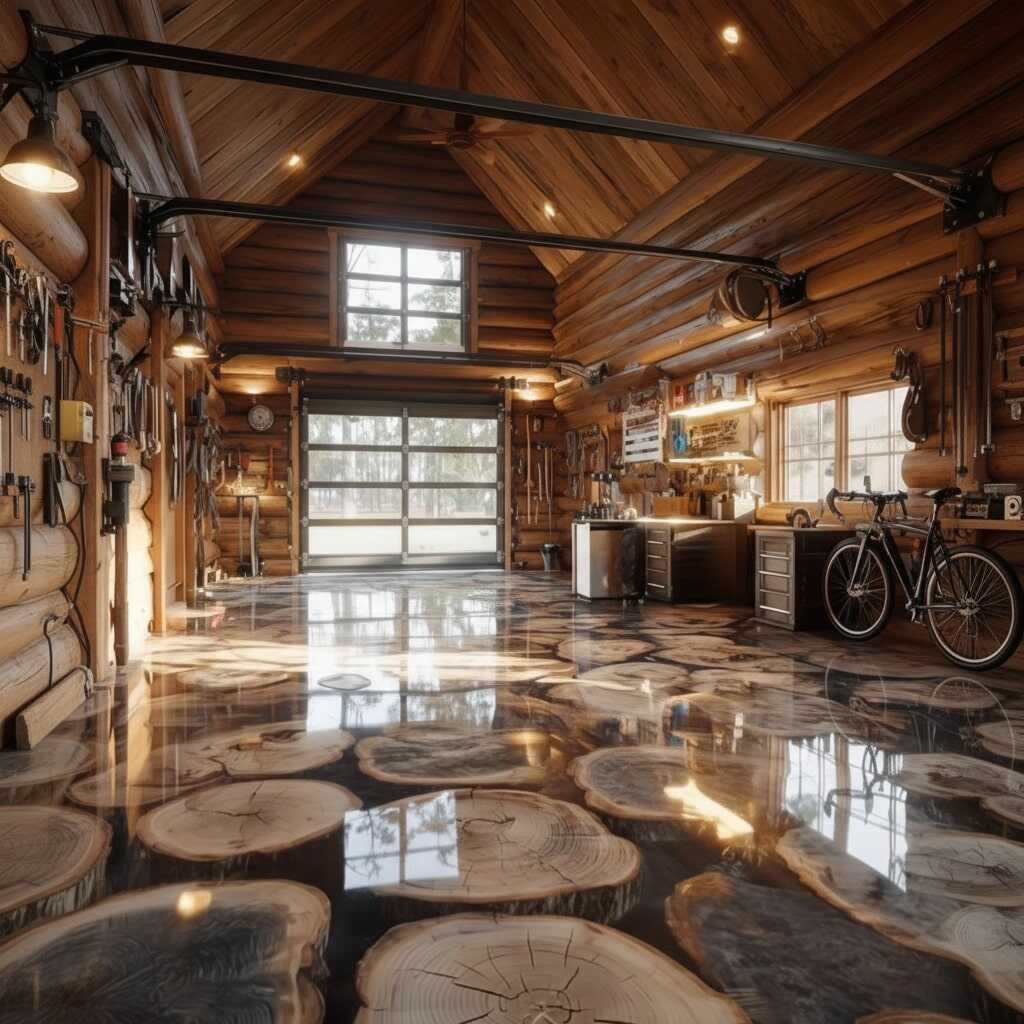
Part I: Reengineering Functionality — Beyond Protection to Performance
At its core, functionality is about performance: how well a system serves its intended purpose under real-world conditions. Concrete, while strong in compression, is fundamentally vulnerable—porous, brittle, and chemically reactive. Spilled oil, antifreeze, battery acid, or de-icing salts don’t just sit on its surface; they penetrate, staining permanently and accelerating micro-fractures. Tire marks embed like tattoos. Moisture wicks up from the ground, fostering efflorescence and mold. Dust particles—tiny shards of degraded concrete—lift into the air with every footstep or vehicle movement.
Epoxy garage flooring intervenes at the molecular level. It is not paint; it is a thermosetting polymer formed by the chemical reaction between epoxide resin and polyamine hardener. Upon curing, it creates a continuous, monolithic film—impermeable, cross-linked, and covalently bonded to the substrate. This is not surface dressing; it is structural integration.
Chemical and Physical Resilience
A properly installed epoxy system resists a staggering array of stressors. Its non-porous nature creates a barrier against hydrocarbons, solvents, acids, and alkalis—substances that degrade concrete in weeks can sit on epoxy for days with no penetration. This resistance isn’t passive; it’s active preservation. By sealing the concrete, epoxy prevents the ingress of water and chlorides that cause rebar corrosion and spalling, effectively extending the slab’s structural lifespan.
Mechanically, cured epoxy exhibits exceptional compressive and tensile strength—often exceeding 10,000 psi in compression—making it resilient to heavy static loads (tool chests, lifts, stored equipment) and dynamic impacts (dropped tools, jack stands). Unlike paint, it does not peel or flake under thermal cycling; its coefficient of thermal expansion closely matches that of concrete, minimizing delamination risk.
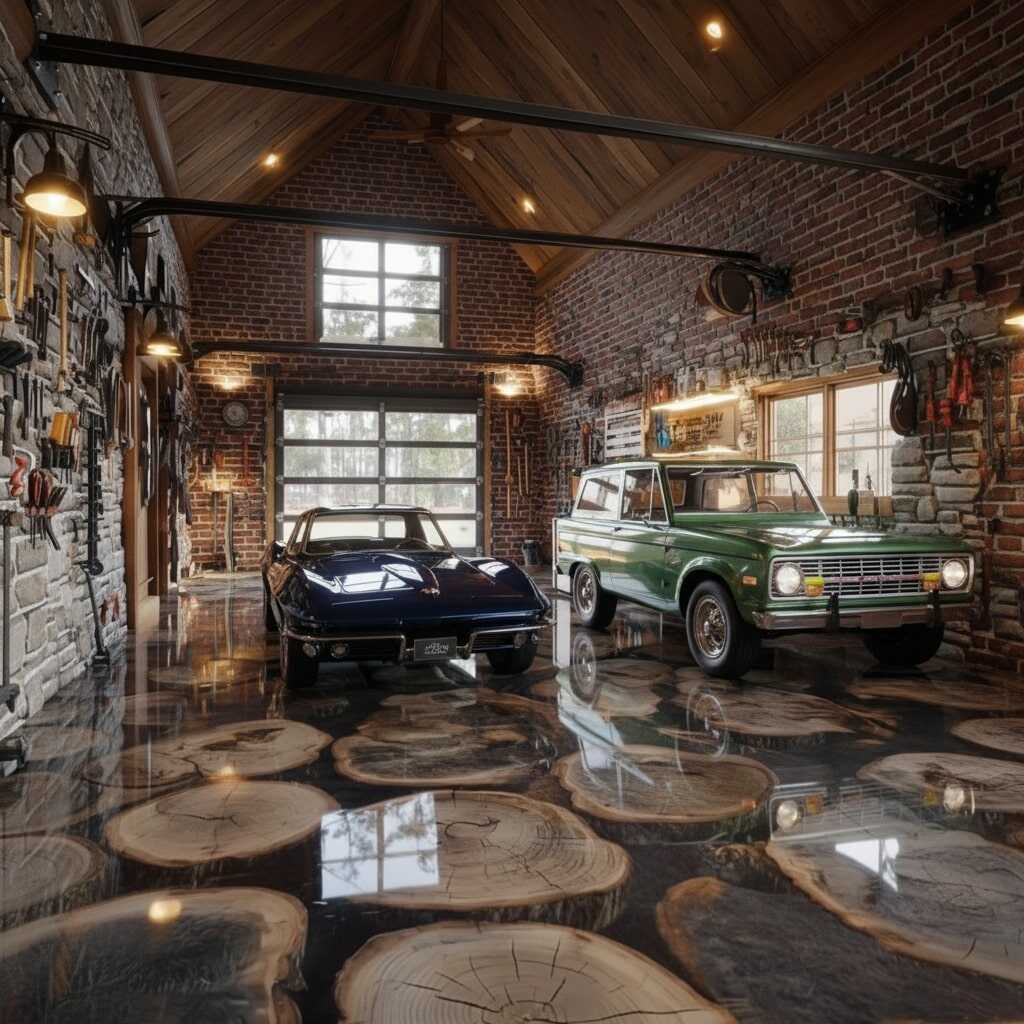
Hygiene and Maintenance Reimagined
Functionality extends to cleanliness. Traditional concrete acts as a reservoir for contaminants: oil migrates deep into capillaries; rubber residue binds irreversibly; mold spores colonize micro-pores. Cleaning is Sisyphean—scrubbing may lift surface grime but cannot restore porosity or neutralize embedded toxins.
An epoxy-coated floor, by contrast, offers cleanability by design. With no pores to harbor filth, contaminants remain on the surface, where they can be easily removed with mild detergents and a squeegee. The result is not just visual tidiness, but a hygienic environment. For households with allergies, for workshops where fine particulate control matters (woodworking, electronics), or for spaces doubling as home gyms, this reduction in airborne dust and microbial reservoirs is profound. The floor ceases to be a source of contamination and becomes part of the solution.
Safety Through Surface Intelligence
Slip resistance is often an afterthought—until an accident occurs. Wet concrete, especially when contaminated with oil or coolant, becomes treacherously slick. Epoxy systems, however, can be engineered for traction. During application, anti-slip aggregates—such as aluminum oxide, silica sand, or polymer grit—can be broadcast into the wet epoxy to create a textured profile. This isn’t an add-on; it’s an intrinsic property calibrated to the user’s needs. A garage used primarily for vehicle storage may require moderate grip; one housing a pottery studio or automotive repair bay demands aggressive traction. The ability to tune friction transforms the floor from a hazard into a safety asset.
Moreover, high-gloss epoxy finishes enhance ambient light reflectivity—often by 200–300% compared to raw concrete. In a space typically plagued by shadowed corners and inadequate overhead lighting, this passive illumination reduces visual fatigue, minimizes tripping hazards, and supports precision tasks without additional energy expenditure. Light becomes functional—not just aesthetic.
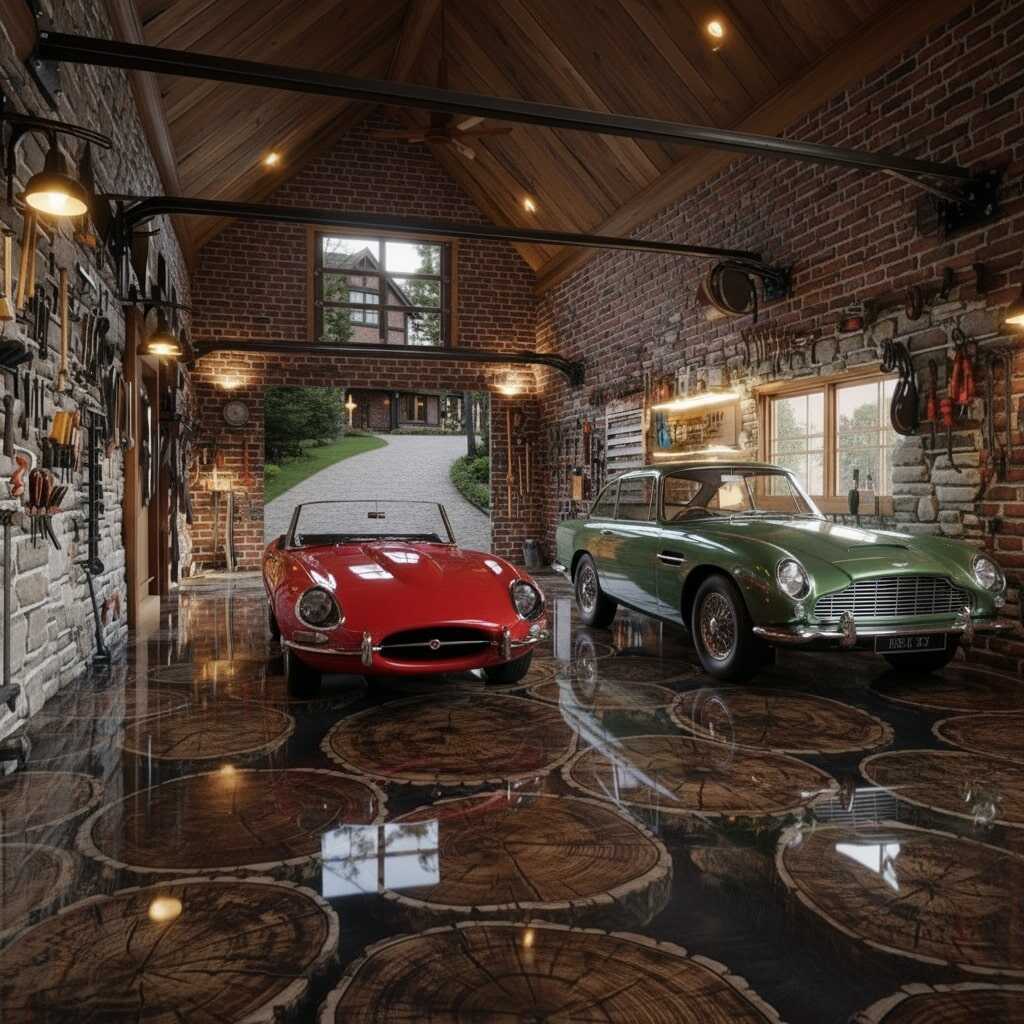
Part II: The Aesthetic Renaissance — From Utility to Expression
If functionality redefines what the floor does, aesthetics redefine what the floor means. For too long, garages have been visually quarantined—hidden behind closed doors, clad in industrial grays, dismissed as unworthy of design consideration. Epoxy garage flooring dismantles that hierarchy. It asserts that beauty is not frivolous, even here; that coherence, color, and craft belong in every inhabited space.
Color as Spatial Architecture
Color in epoxy is not superficial pigment; it is integral to the resin matrix. Unlike paint—where color sits atop a binder and fades or chips—epoxy’s hue is molecular, UV-stabilized (in aliphatic formulations), and locked in for the life of the coating. This enables intentional chromatic design.
Consider the psychological impact of a deep slate gray floor in a minimalist garage—cool, grounded, receding into the background to emphasize clean lines of shelving and tools. Or a warm terracotta base in a sun-drenched southern garage, echoing adobe architecture and radiating comfort. A high-contrast white epoxy can make a compact space feel expansive, while bold navy or forest green can anchor a garage used as a creative studio, evoking focus and calm.
Crucially, color in epoxy is not monolithic. Metallic epoxy systems—where aluminum or mica flakes are suspended in translucent resin—create dynamic, fluid effects. Under changing light, the floor appears to shift: rivers of copper, nebulae of silver, depths of cosmic blue. This is not decoration; it is chromatic kinetics—an environment that responds to time of day, weather, and movement. The floor becomes a living surface, subtly animating the space.
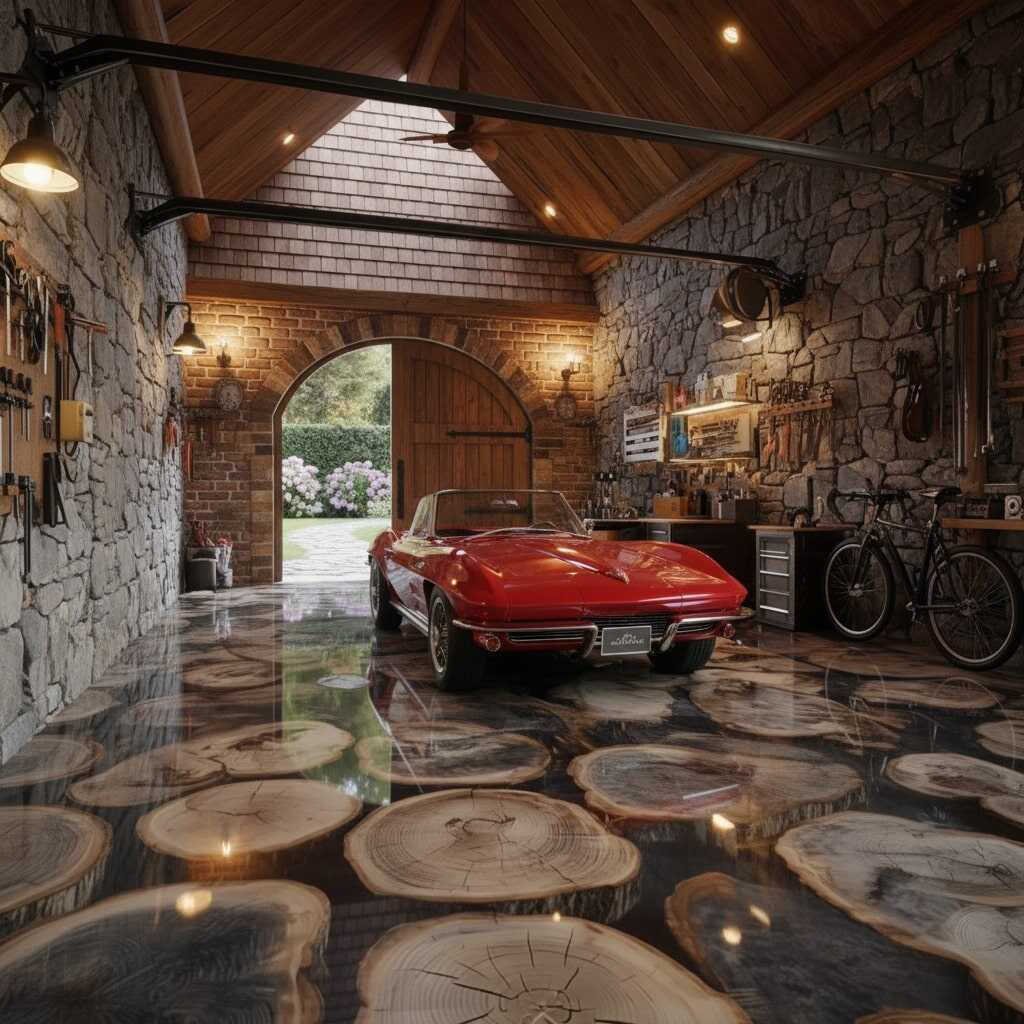
Pattern, Texture, and Narrative
Beyond base color, epoxy invites layering and customization. Flake broadcast systems—where colored vinyl chips are scattered into wet epoxy—produce speckled finishes reminiscent of terrazzo or granite. The scale, density, and palette of flakes can be varied: fine peppering for subtlety, bold confetti-like dispersion for energy.
More advanced techniques include:
- Stenciling and Logos: Integrated into the mid-coat, these can denote zones (e.g., “Workbench,” “EV Charging”), reflect personal identity (a family crest, favorite sports emblem), or reinforce spatial logic—all without adhesives or decals that peel over time.
- Simulated Stone or Tile: Using multi-layer tinting and controlled broadcast, skilled applicators can mimic the veining of marble or the grout lines of ceramic—achieving the elegance of high-end finishes without the fragility or cost.
- Seamless Transitions: Because epoxy cures as a single plane, it eliminates grout lines, expansion joints (when properly joint-recessed), or seams—creating visual continuity from wall to floor, or from garage to adjacent mudroom. This seamlessness fosters spatial unity, dissolving the perceptual boundary between “garage” and “home.”
Material Honesty and Craft
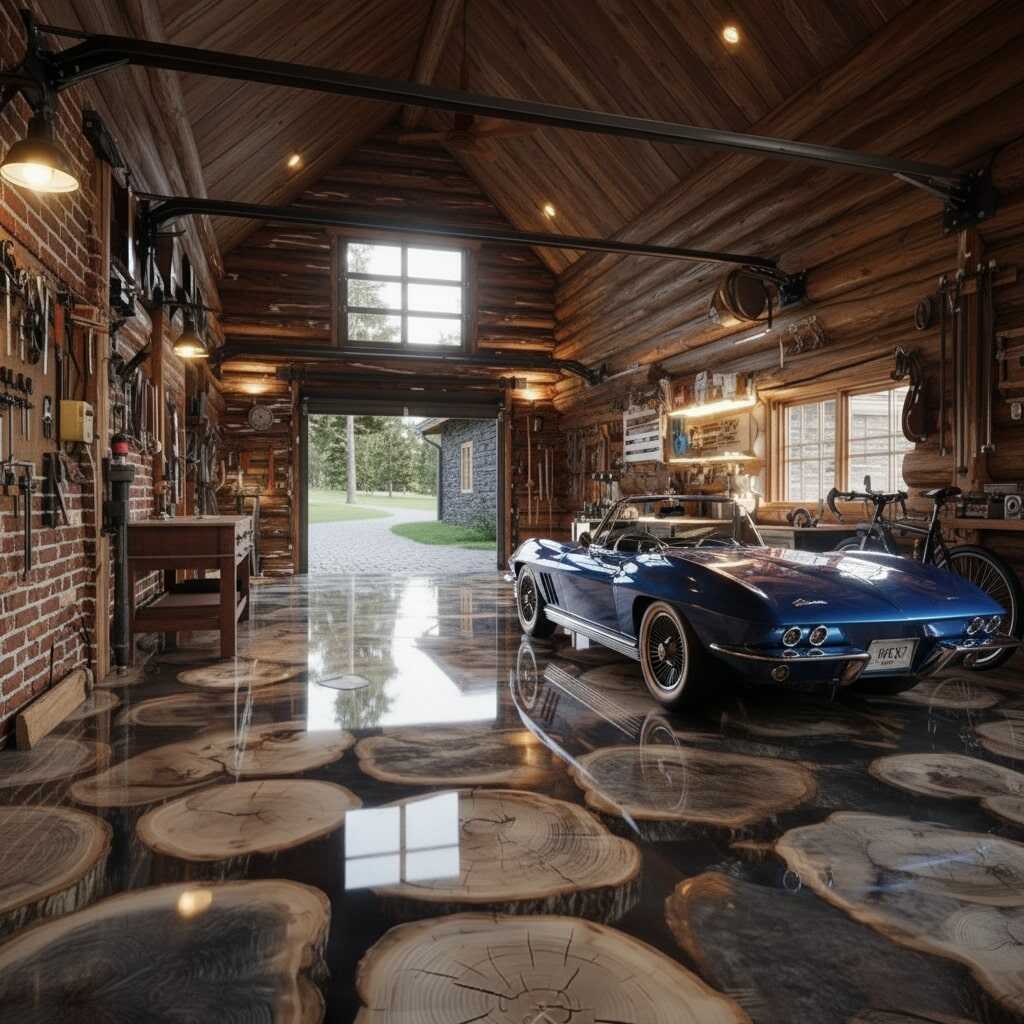
Aesthetics in epoxy also lie in its material truth. Unlike faux finishes that imitate wood or stone through printed veneers, epoxy does not pretend to be something else. Its gloss, its depth, its slight elasticity underfoot—these are authentic expressions of polymer chemistry. A high-build epoxy floor, especially when polished post-cure, reveals subtle nuances: the swirl of a trowel pass, the gentle pooling at a drain, the way light refracts through a 1/8-inch-thick resin layer. This is not sterility; it is refined honesty.
In an era of disposable surfaces and planned obsolescence, epoxy’s longevity—15, 20, even 25 years with proper care—carries aesthetic weight. Its endurance becomes part of its character. Minor scuffs don’t degrade it; they become part of a patina. The floor tells a story not of decay, but of sustained utility—of winters weathered, projects completed, bicycles leaned against walls, children’s chalk drawings wiped clean.

Part III: The Synthesis — Where Utility and Beauty Converge
The true power of epoxy garage flooring emerges not in its functional or aesthetic virtues alone, but in their synthesis. When a surface is both effortlessly cleanable and visually serene, it ceases to be a compromise and becomes an enabler.
Imagine a garage transformed into a woodworking studio: the epoxy floor resists sawdust abrasion and finishes stains, while its matte-silver metallic sheen reflects task lighting evenly across the workbench, reducing eye strain. Or a family’s “drop zone”—where strollers, sports gear, and grocery bags converge—benefiting from seamless, non-porous flooring that wipes clean in seconds, all unified in a warm greige tone that echoes the home’s interior palette.
This convergence elevates the garage from periphery to participant. No longer a dumping ground, it becomes a space worthy of lingering in—a place where form and function conspire to support daily rituals with grace. The psychological shift is subtle but significant: when a space feels intentional, behavior changes. Tools are returned to their places. Surfaces are maintained. The garage door stays open on summer evenings, inviting connection rather than concealment.
Even sustainability finds expression in this synthesis. By extending the life of existing concrete slabs—avoiding demolition, hauling, and new material production—epoxy embodies preservation through innovation. It aligns with circular design principles: optimizing what already exists, minimizing waste, and prioritizing longevity over novelty.
Conclusion: The Floor as Foundation—For Space, and for Living
To speak of epoxy garage flooring solely in terms of gloss, color, or chemical resistance is to miss its deeper resonance. It is, at heart, an act of reclamation—reclaiming a neglected surface, reclaiming a marginalized space, reclaiming the idea that every square foot of our environment deserves thoughtful stewardship.
The garage floor, once a passive recipient of wear, becomes an active collaborator: protecting, reflecting, guiding, enduring. It supports the weight of SUVs and the light tread of bare feet with equal fidelity. It accommodates the chaos of a home renovation and the stillness of an early-morning yoga session. In its seamless expanse, we find not sterility, but potential—the potential for order within activity, for beauty within utility, for dignity within the everyday.
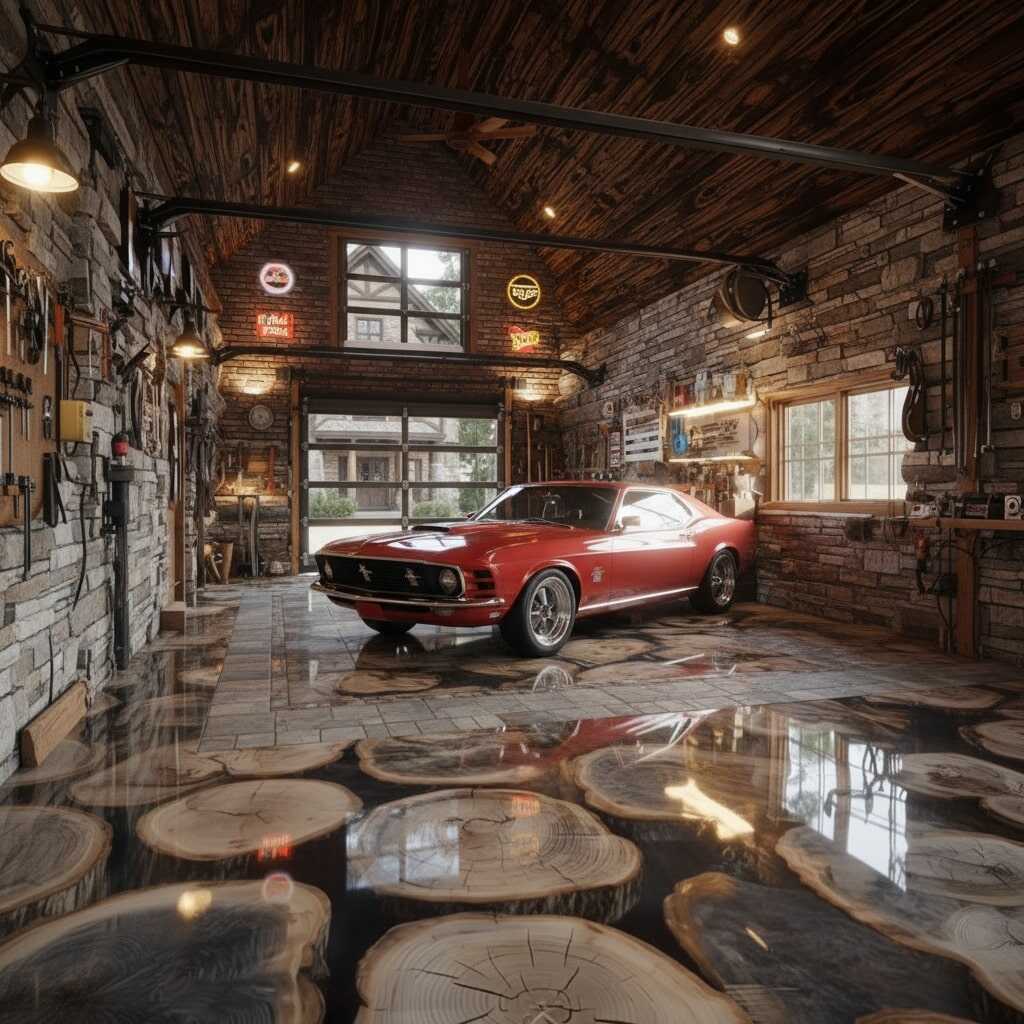
In transforming functionality and aesthetics, epoxy does more than coat concrete. It redefines thresholds. It invites us to reconsider where life happens—and to invest, even in the unlikeliest of places, in surfaces that serve not just our needs, but our aspirations. The garage, with its newly realized floor, is no longer just a place to park the car. It is a space ready—for work, for rest, for creation, for connection.
And it all begins beneath our feet.