For millennia, the idea of walking on water has captivated the human imagination. From mythological tales of deities striding effortlessly across oceans to biblical accounts of miracles, the notion has long symbolized transcendence—rising above the natural limitations of the physical world. In modern times, this dream has migrated from the realm of fantasy into the domain of engineering and fluid dynamics. Today, it is no longer confined to stories or cinematic illusions; it is a tangible, albeit fleeting, reality made possible by a remarkable invention: Water Jet Shoes.

Water Jet Shoes—also known as water hover shoes, hydro jet boots, or aquatic propulsion footwear—are wearable devices that enable individuals to levitate above, skim across, and even perform aerial maneuvers on the surface of water. Unlike traditional water sports equipment that rely on buoyancy or planing surfaces, these devices harness the raw power of pressurized water jets to generate thrust, effectively countering gravity and allowing the user to “walk on water” in a literal, physics-driven sense. But how exactly do they achieve this? What principles of science make such a feat possible? And what does this technology reveal about humanity’s ongoing quest to defy natural constraints?
This article delves deep into the mechanics, physics, and engineering that underpin Water Jet Shoes. We will explore the fundamental forces at play, dissect the components that make these devices function, and examine the delicate balance of control, stability, and power required to sustain human locomotion atop a fluid surface. Far from mere novelty gadgets, Water Jet Shoes represent a sophisticated convergence of Newtonian mechanics, fluid dynamics, and real-time human-machine interaction—a testament to how scientific understanding can transform ancient dreams into engineered reality.
Part I: The Physics of Defying Gravity on Water
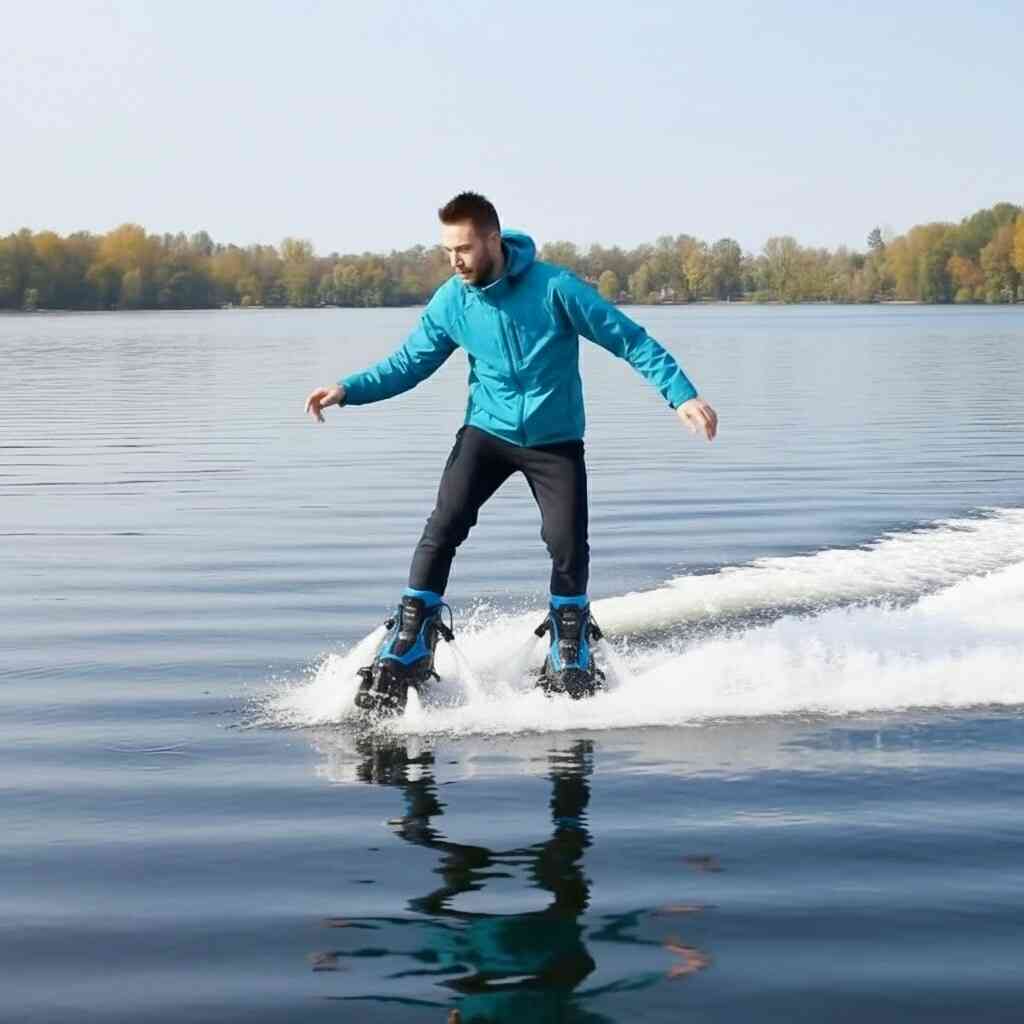
At the heart of Water Jet Shoes lies a deceptively simple principle: action and reaction. This is Newton’s Third Law of Motion in its purest form—“For every action, there is an equal and opposite reaction.” When water is expelled downward at high velocity from nozzles beneath the user’s feet, it creates an upward thrust that counteracts the force of gravity. If this thrust exceeds the user’s weight, lift is generated, and the person rises above the water’s surface.
Water Jet Shoes are typically connected via a hose to a high-pressure water pump, often mounted on a personal watercraft (PWC) like a jet ski. The pump draws in ambient water and pressurizes it, forcing it through the hose and out through nozzles positioned under the user’s feet. Pressures can exceed 100 psi (pounds per square inch), with flow rates reaching 1,000 liters per minute or more. The resulting jets can exit at speeds upwards of 60 km/h (37 mph), generating enough upward force to lift an adult human—typically requiring 800 to 1,200 newtons of thrust, depending on body mass.
But lift alone is not enough. Water is an unstable medium; unlike solid ground, it offers no static reaction force. Once airborne, the user is essentially in a state of controlled freefall, balanced precariously between gravitational pull and jet propulsion. This introduces the challenge of dynamic equilibrium—maintaining stability not through passive support, but through continuous, active adjustment of thrust vectors.
Part II: Engineering the Illusion—Components and Control Systems
The functionality of Water Jet Shoes hinges on a synergy between mechanical design, fluid delivery, and human proprioception. Let’s break down the core components that enable this water-walking phenomenon.
1. The Propulsion Unit (Pump Source)
As mentioned, most Water Jet Shoes systems rely on an external pump, usually integrated into a jet ski. This is not arbitrary—it’s a matter of power-to-weight ratio. Generating the necessary water pressure and flow requires a motor of significant horsepower (typically 130–300 HP). Carrying such a motor on one’s back would be impractical and unsafe. By tethering the user to a floating power source, engineers offload the heaviest components while maintaining a flexible, high-flow water supply through a reinforced hose (often 10–15 meters long).
2. The Hose and Swivel Joint
The hose must withstand high internal pressures while remaining flexible enough to allow full range of motion. It typically features multiple layers of braided polymer or fiber reinforcement. Crucially, a 360-degree swivel joint is installed near the user’s waist or backpack harness. This prevents hose twisting during spins or turns—a common issue that could otherwise restrict movement or cause dangerous torque on the body.

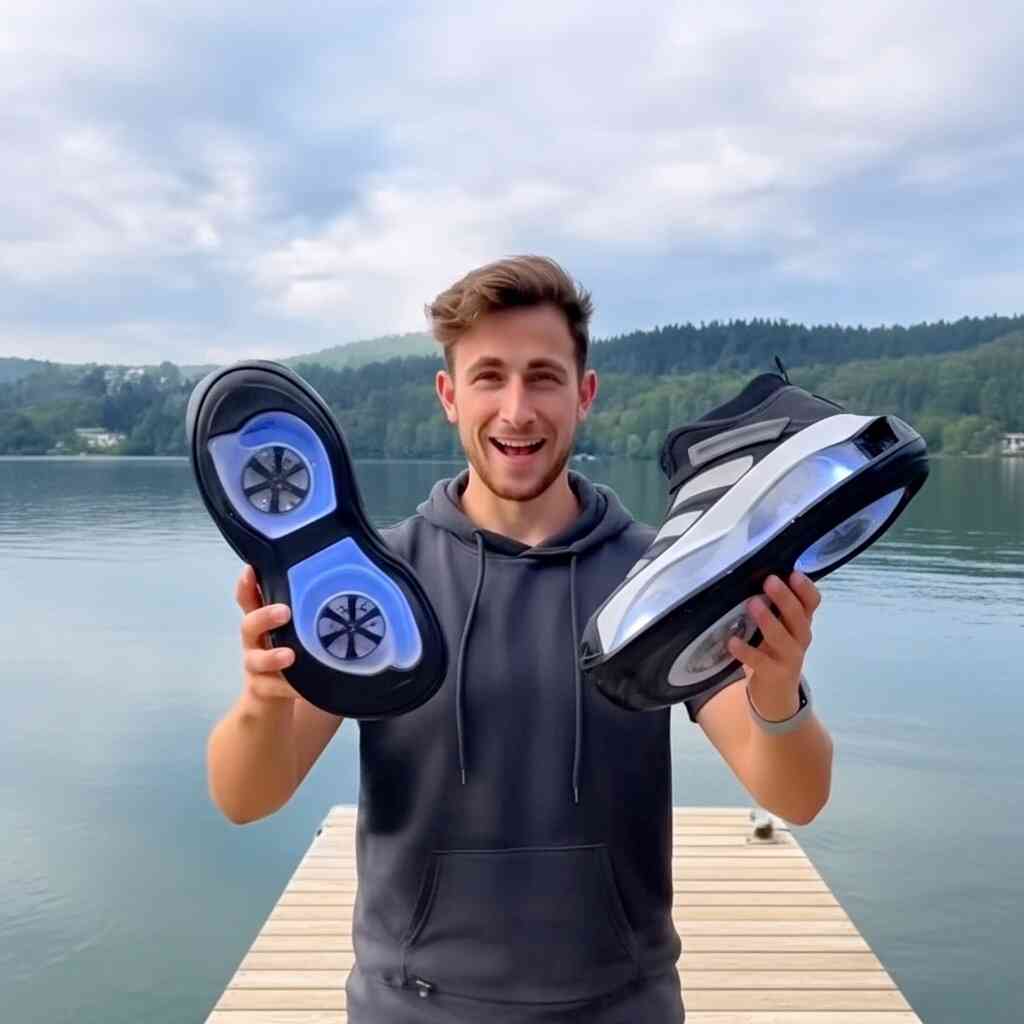
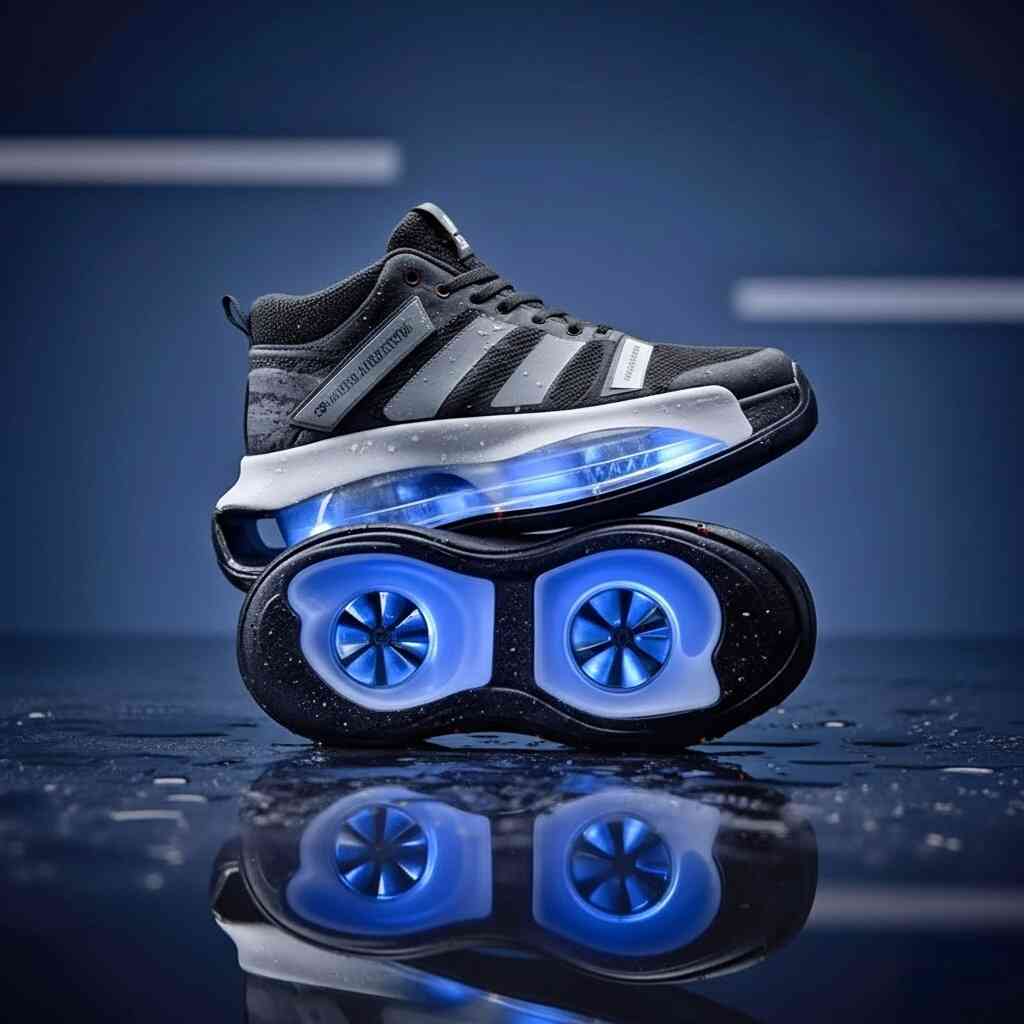
3. The Jet Shoes Themselves
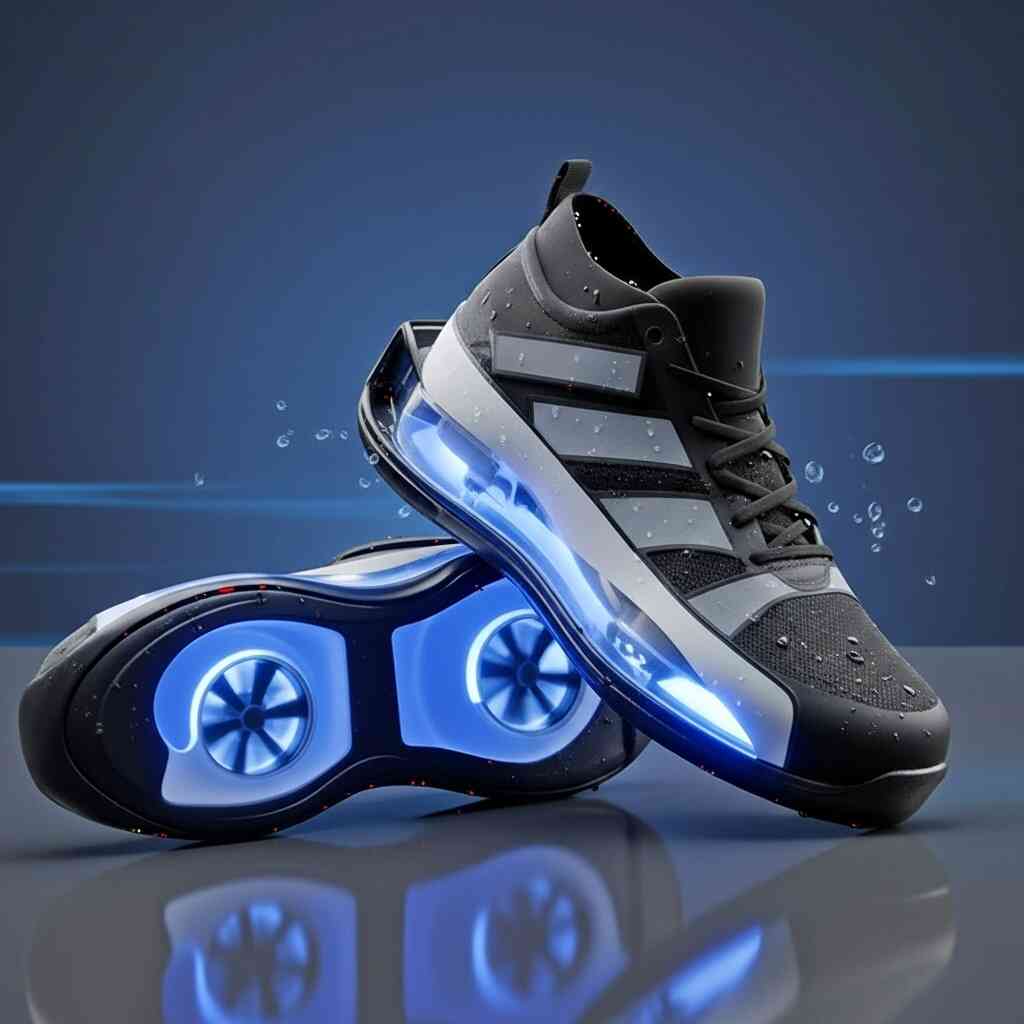
Each shoe houses one or more precision-engineered nozzles, often made of stainless steel or high-grade composites to resist corrosion and erosion from high-velocity water. The nozzles are angled slightly outward or downward, depending on the desired flight characteristic. Some advanced models include adjustable nozzle angles, allowing users to fine-tune lift versus forward thrust.
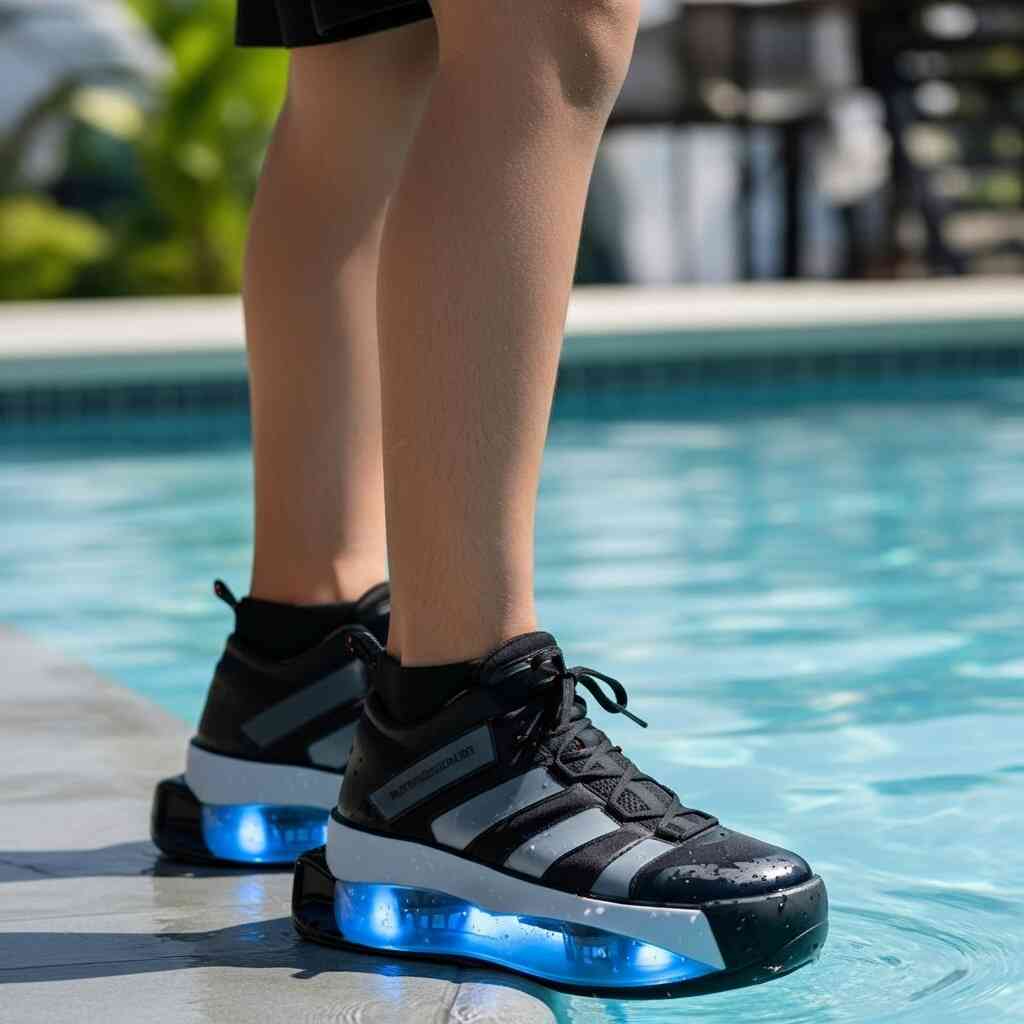
Inside the shoe, a manifold distributes incoming water evenly to each nozzle. The footwear is designed to be buoyant when inactive, ensuring the user doesn’t sink when the jets are off. Foot straps or bindings secure the user’s feet, providing a stable platform for balance—though unlike skis or snowboards, there is no edge to “carve” with; all directional control comes from body posture and jet vectoring.
4. Human as the Control System
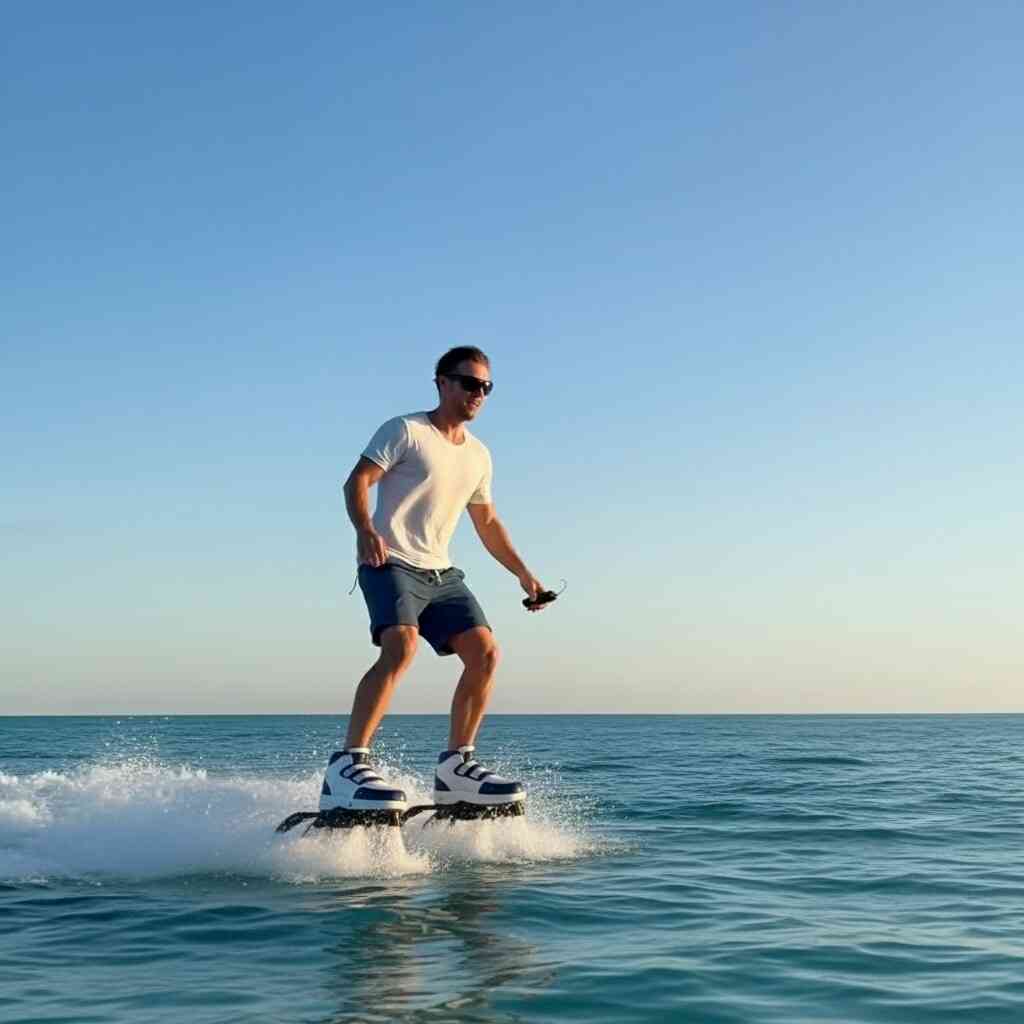
Perhaps the most fascinating aspect of Water Jet Shoes is that the user is the flight control system. There is no onboard computer, gyroscope, or auto-stabilization (in standard recreational models). Instead, balance is maintained through subtle shifts in body weight, ankle flexion, and arm positioning—much like riding a unicycle or balancing on a slackline, but in three dimensions over an unforgiving surface.
Leaning forward increases horizontal thrust, propelling the user across the water. Leaning back reduces forward motion and increases vertical lift. Tilting one foot more than the other induces a turn. Rapid, coordinated movements can produce flips, spins, or hovering. This demands exceptional core strength, spatial awareness, and rapid neuromuscular feedback—making the experience as much a test of human physiology as it is of engineering.
Interestingly, the brain adapts surprisingly quickly to this new mode of locomotion. Within minutes, many users begin to internalize the cause-effect relationships between posture and motion, effectively “rewiring” their motor control to accommodate the jet-propelled environment. This neuroplasticity underscores how humans can extend their physical capabilities through intuitive interaction with mechanical systems.
Part III: Fluid Dynamics, Stability, and the Limits of Water Walking
While the basic principle of thrust generation is straightforward, the real complexity of Water Jet Shoes emerges when we consider the interaction between high-speed jets, the water surface, and aerodynamic forces.
Surface Interaction and Cavitation
When the jet nozzles are too close to the water surface, the expelled water can entrain air, creating a frothy mixture that reduces thrust efficiency—a phenomenon related to cavitation. Conversely, if the user ascends too high, the hose length limits altitude (usually to 6–10 meters), and the increased distance can lead to pressure drop and reduced responsiveness. Optimal operation occurs in a narrow “sweet spot” just above the surface, where the jet remains coherent and the reaction force is maximized.
Moreover, the water surface itself is rarely perfectly calm. Waves, wind, and turbulence introduce perturbations that the user must constantly compensate for. A passing wake or gust of wind can destabilize the delicate equilibrium, requiring immediate corrective action. This dynamic instability is why beginners often describe the experience as “like standing on two fire hoses”—powerful, unpredictable, and demanding constant attention.
Energy Efficiency and Thermodynamics
It’s worth noting that Water Jet Shoes are inherently inefficient from a thermodynamic standpoint. Most of the engine’s energy is lost as heat, turbulence, and sound, with only a fraction converted into useful thrust. The system operates far from ideal Carnot efficiency, but this is an acceptable trade-off for a recreational device where performance and spectacle outweigh energy conservation.
Nevertheless, engineers continually refine nozzle geometry, hose diameter, and pump impeller design to minimize losses. Computational fluid dynamics (CFD) simulations are now used to model water flow through the entire system, optimizing for laminar flow and minimal pressure drop. Even small improvements—such as smoothing internal hose bends or using hydrophobic nozzle coatings—can yield noticeable gains in responsiveness and lift.
The Boundary of Human Capability
Despite their apparent simplicity, Water Jet Shoes push the boundaries of what the human body can manage in an unstructured fluid environment. They require not only physical strength but also a deep, intuitive understanding of force vectors and momentum conservation. The sensation of hovering over water—feet unsupported, body suspended by invisible columns of pressurized liquid—is profoundly disorienting at first, yet exhilarating once mastered.
This duality reflects a broader truth about technological augmentation: tools like Water Jet Shoes don’t just extend our physical reach; they expand our perceptual and cognitive frameworks. By engaging with forces that are normally imperceptible—thrust, drag, torque—we develop a richer, more embodied understanding of physics. In this sense, walking on water becomes not just a spectacle, but a form of kinetic education.
Conclusion: More Than a Stunt—A Dialogue Between Humanity and Nature
Water Jet Shoes are often dismissed as extreme sports toys or viral internet sensations. But beneath the spray and acrobatics lies a profound demonstration of scientific principles in action. They embody Newton’s laws not as abstract equations, but as visceral, lived experiences. They transform water—a substance we typically float on or swim through—into a medium for propulsion, elevation, and aerial expression.
The science behind Water Jet Shoes reveals a delicate choreography between engineered power and human adaptability. It is not enough to generate thrust; one must learn to dance with it. This interplay mirrors humanity’s broader relationship with nature: we do not conquer natural forces, but learn to collaborate with them, using knowledge to navigate their complexities.
Walking on water was once a metaphor for the impossible. Today, thanks to fluid dynamics, precision engineering, and human ingenuity, it is a controlled, repeatable phenomenon—one that continues to inspire awe not because it defies nature, but because it reveals nature’s hidden possibilities. Water Jet Shoes remind us that the boundary between myth and reality is often just a matter of understanding the right physics—and having the courage to step into the jet stream.